On Carthage
Carthage | Qart Hadasht | Qart-ḥadašt | 𐤒𐤓𐤕𐤟𐤇𐤃𐤔𐤕 | New City
- 𐤒 (Q)
- 𐤓 (R)
- 𐤕 (T)
- 𐤟 (word divider)
- 𐤇 (H)
- 𐤃 (D)
- 𐤔 (SH)
- 𐤕 (T)
Almost every written word in their own voice, their music, their stories, their perspectives on themselves and others has been entirely lost. We're left piecing together fragments to glimpse what must have been an extraordinary place.
When we cobble together as many existing sources as we possibly can, the image that forms is of a bustling, wealthy, multicultural port city. Think Venice, Amsterdam, or Hong Kong - where wealth, trade, and cultural exchange created a unique urban energy and attitude.
Glimpsing an alternate version of antiquity - one centered on trade rather than conquest, on practical innovation rather than philosophical speculation, on multicultural pragmatism rather than cultural imperialism. There really is something spectacular here.
Here's a speculative but informed picture of life's rhythm in the new city:
During Trade Season (Spring/Summer):
- Bustling excitement as ships arrived
- Pride in their naval expertise
- Young sailors showing off their skills
- Markets full of exotic goods
- Wealthy merchants in purple clothes conducting business
- The sound of multiple languages in the streets
- Smell of garum and spices from the markets
- Barbary macaques causing mischief among the crowds.
- Occassional religious ceremonies for safe voyages.
- The satisfaction of wealth flowing into the city
Rainy Season (Winter):
- More indoor focused life
- Satisfaction watching the cisterns fill
- Appreciation for their engineering as water systems worked
- Probably some smugness about having better winter preparations than other cities
- Indoor entertainment, storytelling, music
- Smaller trade activity but still busy ports
- Planning for spring ventures
- Religious festivals to ensure good fortune
The Social Atmosphere:
- Likely a certain arrogance from success (matches descriptions of young men)
- Pride in their technical achievements
- Cosmopolitan attitude from extensive trade
- Conservative older generation (as shown by the Council of 104)
- Probable tension between traditional values and merchant wealth
- Strong sense of privacy and discretion about business
- Religious devotion mixed with practical commerce
- Multilingual environment with Greek, Punic, and other languages
- Competition between wealthy families
- Probably some resentment between merchant class and old nobility
Daily Life:
- Morning markets busy with trade
- Harbor constantly active
- Religious observances threading through daily life
- Wealthy areas probably had a leisurely pace
- Industrial districts (like the metal works) bustling with activity
- Cultural sophistication (shown by love of Athenian pottery)
- Mix of local and foreign fashions
- Entertainment in the evenings (music we discussed)
- Likely rivalry between different city districts
- Pride in their unique identity distinct from Greeks/Romans
Overall Theme
- Phoenician traditional values
- Merchant wealth and sophistication
- Naval pride
- Religious devotion
- Cultural confidence
- Technical innovation
- International trade savvy
- Technologically innovative (those standardized ship parts, the calcium-enhanced iron, the incredible harbor engineering)
- Culturally sophisticated (their love of fine Athenian pottery while maintaining their own distinct identity)
- Remarkably modern in some ways (their banking systems, assembly lines, urban planning)
- Full of contrasts (conservative council members in their strict political roles while young merchants bragged and raced ships)
- Deeply practical (using Greek as diplomatic language, their water management) yet also maintaining strong traditions
- Monkeys played in merchant gardens while serious financial deals were made
- Ships were mass-produced in the world's first known assembly line
- Young men showed off dangerous sailing skills then drank from imported Greek vessels
- Conservative elders in their purple robes managed an empire from a tower in a perfect circular harbor
- Engineers created innovations in metallurgy and hydraulics that were centuries ahead of their time
- Multiple languages echoed through markets selling goods from three continents
Carthaginian Goods and Services
- Purple dye (from murex shells - one of their most famous exports)
- Textiles dyed with their famous purple
- Ivory (both raw and carved)
- Gold (from West Africa)
- Silver (from Spain)
- Tin (crucial for bronze-making)
- Copper
- Lead
- Iron from Spain
- Slaves
- Wild animals for Roman games
- Grain/wheat (especially from Sicily)
- Olive oil
- Wine
- Garum (fish sauce)
- Salt
- Dates
- Figs
- Nuts
- Ceramic goods
- Glass items
- Perfumes
- Incense
- Spices from trade routes
- Horses (particularly from North Africa)
- Timber (especially cedar from Lebanon)
- Carthaginian metalwork
- Jewelry
- Naval technology/shipbuilding expertise
- Navigational knowledge (they were famously secretive about trade routes)
- Agricultural knowledge (preserved in Mago's treatise)
- Mercenary services (they were known for hiring and providing military forces)
- Banking/financial services (they had sophisticated financial systems)
- Architectural knowledge (especially regarding water management)
- Religious practices (cultural exchange with other Mediterranean peoples)
- Carthaginian furniture (especially wooden luxury items)
- Wool and wool products
- Honey
- Precious stones
- Ship construction services
The Harbor
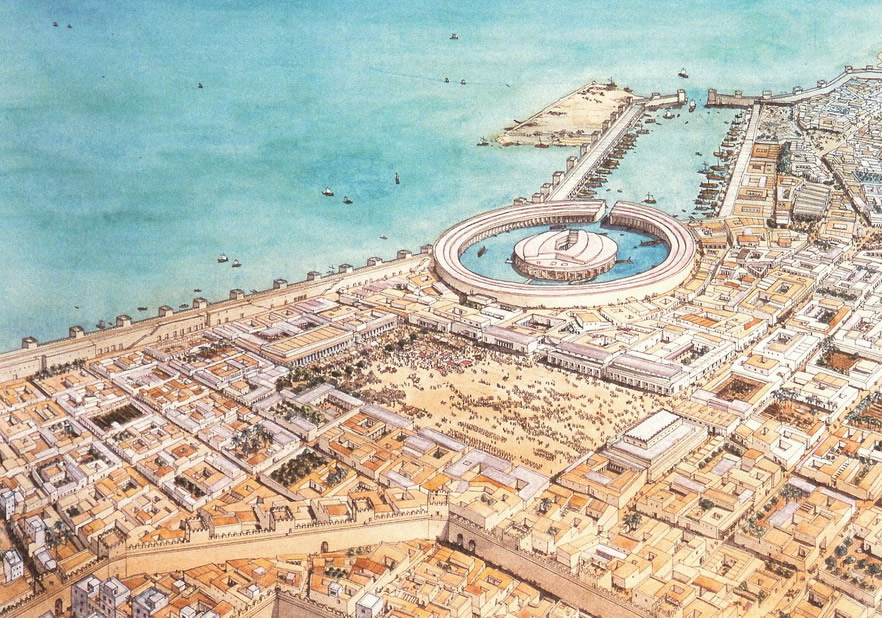
Divided into a military circiular harbor with the Byrsa citadel situated in the middle, and a commercial rectangular harbor, the remarkable double-harbor is the flagship feature of the City of Carthage.
The inner harbor could reportedly hold up to 220 ships. It was designed in a way that boats passing by could never quite see what was going on in there, and the commercial harbor had a raising chain and acted as a defensive buffer during times of naval combat.
From the Byrsa, the military command had a full 360 view of the surrounding area, could monitor the horizon for incoming trade vessels, weather, and enemy espionage.
Trade with Athens
The Carthaginians were particularly enthusiastic collectors and importers of high-end Athenian pottery, especially black-figure and later red-figure vases. This taste for Athenian ceramics reveals several interesting aspects about Carthaginian culture:
- They particularly favored drinking vessels and symposium (drinking party) equipment, suggesting they may have adopted some Greek-style dining/drinking customs among the elite
- Archaeological evidence shows they were willing to pay premium prices for the finest Athenian pieces
- Some pieces found in Carthaginian tombs show they valued these vessels enough to include them as grave goods
- There's evidence that some Athenian potters may have created pieces specifically for the Carthaginian market
- The trade was substantial enough that it influenced maritime routes, with ships stopping at Carthage on their way to and from other Mediterranean ports
This appreciation for Athenian pottery continued even during periods when Carthage was in conflict with Greek cities in Sicily, showing how trade and cultural appreciation could continue even during political tensions.
Cisterns built into the walls for rainwater collection
The Carthaginians developed an impressive system of rainwater storage by building cisterns directly into their city walls and underneath buildings. These cisterns were lined with waterproof hydraulic cement (a technique they may have developed or refined) to prevent leakage.
The system was particularly remarkable because Carthage didn't have natural springs or a river within the city, so water management was crucial. The cisterns collected rainwater that ran down from the Byrsa hill and other elevated areas of the city through a network of channels and pipes.
Some of these cisterns were massive - the largest surviving ones from the later Roman rebuilding of Carthage (which likely followed similar principles to the Punic originals) are the Malga Cisterns, which could hold millions of liters of water. While these specific ones are Roman-era, they were probably built on or inspired by earlier Punic engineering principles.
The wall-integrated cistern system helped make Carthage extremely resilient to siege warfare, since water supply was often a critical weakness for ancient cities under siege.
Industrial Shipbuilding Assembly Lines
The Carthaginians developed a remarkably efficient shipbuilding system that used standardized, pre-fabricated parts and an assembly-line approach. Archaeological and textual evidence suggests:
- They used a system of standardized parts marked with Punic letters/numbers
- Different teams specialized in creating specific components
- The process was divided into distinct stages and areas
- They could reportedly build a warship in 6-8 weeks
- The circular military harbor had specialized construction/repair stations arranged around it
Key innovations:
- Pre-cut timber pieces stored ready for assembly
- Standardized keel sections
- Interchangeable parts
- Assembly markers to guide construction
- Division of labor into specialized teams
This system allowed them to:
- Replace damaged ships quickly
- Maintain quality control
- Train workers efficiently
- Scale production up or down as needed
- Maintain consistent designs
Signs of Steel Production 2000 years before the Industrial Revolution
The Carthaginians had sophisticated metallurgical techniques, and archaeological evidence from a metalworking district outside the western walls has revealed some interesting innovations:
- They developed a technique of adding calcium to iron, which appears to have improved the quality of the metal
- The discovery of specialized blow valves/tuyères (nozzles for forcing air into a furnace) suggests advanced temperature control
- The industrial suburb shows evidence of organized mass production
The location outside the walls was likely chosen for:
- Fire safety
- Access to trade routes
- Wind patterns for the furnaces
- Space for large operations
Military Outsourcing Strategy
The shift from citizen soldiers to mercenaries in Carthaginian military organization is a notable part of Carthage's history:
Initially:
- Carthage had a strong citizen militia tradition
- Upper class citizens served as officers and cavalry
- Middle class citizens formed heavy infantry
- The system was similar to other Mediterranean city-states
- Citizens were expected to provide their own equipment
The Change:
- As Carthage got wealthier through trade, citizens became less interested in military service
- Merchant class increasingly focused on commerce
- Began relying more on mercenaries and professional soldiers
- By the time of the Punic Wars, the citizen militia was mainly just defending the city itself
- Naval service remained more popular among citizens than land warfare
Problems This Caused:
- Expensive to maintain mercenary armies
- Loyalty issues (famous mercenary revolt after First Punic War)
- Loss of military experience among the citizenry
- Dependency on foreign troops
- Sometimes mercenaries would switch sides
- Harder to raise emergency forces when needed
The Hannibal Exception:
- During the Second Punic War, Hannibal managed to inspire more citizen participation
- His core African troops were more loyal than typical mercenaries
- But this was more exception than rule
Carthaginian Banking and Financial Innovation
- A system of negotiable instruments similar to checks
- Letters of credit for international trade
- Complex accounting systems
- Investment partnerships for trading ventures
- Marine insurance concepts
- Sophisticated contract law
- Banking families that operated across the Mediterranean
- Credit networks between merchants
Money and Currency:
- Minted their own coins
- Used a variety of foreign currencies
- Had systems for managing exchange rates
- Developed methods for verifying metal purity
- Used both precious metals and credit instruments
- Had standardized weights and measures
- Sophisticated record-keeping systems
Trade Finance:
- Funded trading expeditions
- Risk-sharing arrangements
- Investment pools for large ventures
- Systems for managing multiple investors
- Methods for dividing profits
- Insurance against losses
- Credit arrangements for merchants
State Finance:
- Complex tax collection system
- Public treasury management
- State banking functions
- Funding for public works
- Management of war finances
- International payments systems
- Sophisticated debt management (as shown by paying off their debt after the punic wars, to which Rome gave them 50 years, and it was paid in 10)

Hannibal
There were actually mutliple Hannibal's, as evident by the Punic-Sicilian wars that predate the Punic-Romana wars people are more familiar with.
"Hannibal" (meaning "Grace of Baal") was actually a fairly common Carthaginian name, particularly among elite families.
- "Hanni" (grace/favor)
- "Ba'al" (the god)
"Hanni-ba'al bar-kah" with that downward tone on the final 'h' (probably more of a heavy aspirated sound than our modern 'h') would be much closer to how it actually sounded, especially with:
- The distinct break between "Hanni" and "ba'al"
- The guttural 'ayin' sound in "ba'al"
- "bar" meaning "son of" or "of the house of"
- That characteristic downward inflection on the final aspirated 'h' in "kah"
The Most Famous:
- Hannibal Barca (247-182 BCE) - crossed the Alps, Second Punic War
Earlier Hannibals:
- Hannibal Mago - led forces in Sicily around 410 BCE in wars against Greek cities
- Hannibal Gisco - commanded in Sicily during First Punic War (died 258 BCE)
- Several other generals and admirals named Hannibal during the Sicilian campaigns
Punic Language
Here's what we know about the Punic language (their version of Phoenician):
Writing System:
- Consonantal alphabet (22 letters)
- Written right to left
- No written vowels in standard text
- Later Neo-Punic developed some vowel notation
- Had both formal and cursive styles
- Numbers used a decimal system
What Survived:
- Mostly inscriptions on monuments
- Some grave markers
- Commercial marks on pottery
- Religious dedications
- A few fragments of longer texts
- Place names that survived in other languages
- The Poenulus (a play by Plautus with some Punic dialogue)
- Some agricultural terms through Mago's treatise
- A few bilingual inscriptions that help translation
Sound/Structure:
- Related to other Semitic languages
- Had a complex verb system
- Used prefixes and suffixes extensively
- Likely had emphatic consonants
- Probably had similar sounds to Hebrew/Arabic
Social Context:
- Was the administrative language of their empire
- Used for commerce across Mediterranean
- Survived Rome's destruction in rural areas
- Evolved into Neo-Punic
- Saint Augustine mentioned rural people still speaking it in his time
- Different dialects existed across their territory
- Used alongside Greek in diplomacy
- Many Carthaginians were multilingual
Speaking Punic
Common Features:
- Many dental/alveolar consonants (made with tongue against teeth/ridge)
- Frequent use of sibilants (s, sh, th sounds)
- Sharp terminal consonants
- Emphatic consonants (sounds made with constricted throat)
- Hard stops at word endings
- Lots of "t" and "sh" combinations
- Guttural sounds common in Semitic languages
Looking at examples:
- Qart-ḥadašt (that sharp 'sht' ending)
- Mago/Magon (the 'n' ending was common)
- mlkt (common word ending pattern)
- Tanit (another sharp 't' ending)
- words with 'sht' or 'st' combinations appear frequently in inscriptions
The speaking style might have sounded:
- Crisp and precise
- Lots of dental articulation
- Sharp consonant endings
- Distinct syllable breaks
- Strong emphasis on certain sounds
Diplomatic Use of Greek Language
Particularly when negotiating with Rome, Carthage would refuse to speak latin, and Rome would refuse to speak punic, this left the greek language as a neutral third diplomatic middle-ground language.
Council of 104
The Council of 104 (sometimes called the Tribunal of 104) emerged as Carthage evolved from a traditional monarchy to a more oligarchic republic. It served as a check on executive power, particularly watching over the generals and magistrates.
The shift happened gradually - while Carthage maintained its "kings" (suffetes - they actually had two who served as chief magistrates, similar to Roman consuls), their power became increasingly limited by this powerful council. The council members were drawn from the wealthy merchant and landowning families.
One of their key roles was holding military commanders accountable - they could be particularly harsh on failed generals. According to classical sources, unsuccessful commanders could face crucifixion or other severe punishments. This apparently led to some commanders being overly cautious in military operations for fear of punishment if they failed.
The Council was known for its conservatism and stability - members served for life and were largely self-selecting, helping powerful families maintain their influence. They also had a reputation for being quite secretive in their operations.
Barbary Macaques
Carthaginians were noted to have pet monkey's that were quite intelligent. It was a crime punishable by death to kill one. Rome copies this practice from them later on.
Tanit
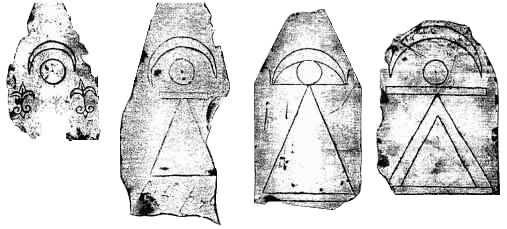
The chief deity of Carthage - a goddess associated with fertility, prosperity, and the moon. She was often depicted with a triangular face or shape and upraised arms, sometimes with a sun disk (called the "Sign of Tanit"). She was the consort of Baal Hammon and became increasingly important in Carthaginian religion over time, eventually becoming the chief deity of the city.
Tanit is an interesting spiritual creature, as unlike many other gods and goddesses of polytheistic society, Tanit seemed to genuinely wish to grant all desires to humans and rarely had strings attached.
Spirituality and Polytheism are very important for understanding past cultures. If you delete it with atheistic views, you miss the entire plot.

Foundational Legend
Dido fled from Tyre (in modern-day Lebanon) after her brother Pygmalion murdered her husband Acerbas (also called Sychaeus in some versions) to seize his wealth, roughly around ~814 BC to find the city of carthage. Dido was a childless widow, making secession of power and claims to the city easier to manage.
Seasons in Carthage
The rainy season in ancient Carthage occurred during the winter months, primarily from October through March/April, which is still the pattern today in that region. The climate was Mediterranean, characterized by:
- Wet winters
- Long, hot, dry summers
- Annual rainfall around 400-500mm (16-20 inches), mostly falling in the winter months
- Most intense rains typically in December and January
This seasonal pattern was one reason why their cistern system was so important - they needed to capture and store the winter rains to help get through the long dry summers. The positioning of Carthage on the Byrsa hill and surrounding slopes actually helped with water collection, as the elevation differences could be used to help channel water into the storage systems.
This climate pattern also influenced their agricultural calendar, which we know a bit about from fragments of Mago's agricultural treatise that survived through Roman sources. Winter crops would have been planted to take advantage of the natural rainfall.
Carthaginian Cuisine
From various archaeological and textual sources, here's what we know about Carthaginian cuisine:
Core Foods:
- Lots of fish dishes (they were a maritime culture after all)
- Olives and olive oil were dietary staples
- Grains, especially wheat and barley
- Lentils and beans
- Dates were particularly important (both fresh and dried)
- Figs were very popular
- Various nuts, especially almonds
- Pomegranates appear frequently in remains
- Grapes, both fresh and as wine
Cooking Methods/Dishes:
- Fish served in many ways (dried, salted, fresh, smoked)
- Bread was a staple, often flatbreads
- Porridge made from various grains
- Stews combining meats, legumes, and vegetables
- Honey was used extensively for sweetening
Meat:
- Lamb and mutton
- Goat meat
- Pork (though less common than in Roman culture)
- Poultry
- Game meats from hunting
Seasonings:
- Garum (yes, they really did put it on almost everything!)
- Salt (they were major salt traders)
- Various herbs native to North Africa
- Imported spices from their trade routes
Drinks:
- Wine (both local and imported)
- Beer (influenced by Egyptian brewing techniques)
- Water mixed with wine was common
- Fruit juices, especially grape and pomegranate
Garum - A staple condiment
Garum was made by fermenting fish intestines and other fish parts with salt. The process created a potent, savory liquid that was used as a condiment and flavoring agent in many dishes. Historical records, particularly Roman sources, describe garum as having a strong, salty flavor and pungent aroma.
While we don't have extensive Carthaginian records specifically describing their use of garum, we know from archaeological evidence and mentions in Roman texts that it was widely used in Carthaginian cuisine. The Carthaginians, being a major Mediterranean naval power, had ready access to fish and salt, the key ingredients for garum production.
Leisure in Carthage
Music & Instruments (from archaeological finds and art):
- Double-flutes (similar to Greek aulos)
- Various drums and tambourines
- Lyres
- Cymbals
- Bells (often found in religious contexts)
- Some unique African instruments from trade contacts
Dance & Performance:
- Religious dances are mentioned in sources
- Temple performances for Tanit
- Some evidence of professional entertainers
- Dance scenes appear in artwork
- Festival processions included music and dance
Entertainment/Leisure:
- Drinking parties (similar to Greek symposia - shown by their love of Athenian drinking vessels)
- Gaming pieces found archaeologically
- Dice games
- Board games
- Public festivals and religious celebrations
- Theater (though less evidence than for Greek/Roman)
- Athletics and sports (but less organized than Greek system)
- Horse racing
- Naval demonstrations in the harbor
- Public ceremonies
Luxurious Living:
- Elaborate gardens
- Keeping exotic pets (like those barbary monkeys)
- Fine dining
- Imported wines
- Wearing purple-dyed clothing (status symbol)
- Jewelry and personal adornment
- Decorated homes with mosaics and artwork
- Seaside villas
- Hunting as recreation for elites
Romance in Carthage
Most Likely Pattern:
- Public monogamy (especially among elites)
- Private flexibility
- Practical handling of indiscretions
- Complex social codes rather than rigid rules
- Sophisticated management rather than harsh punishment
- Different standards for different classes
- Pragmatic approaches to human nature
Supporting Evidence:
- Their pattern of public austerity/private luxury
- Sophisticated urban culture
- Complex social hierarchies
- Practical problem-solving approach
- Emphasis on stability over purity
- Strong but adaptable family structures
- Focus on practical outcomes
- Merchant class pragmatism
Marriage Patterns Probably:
- Arranged marriages among elite/trading families
- More flexibility in merchant class
- Focus on business/political alliances
- Practical handling of complications
- Complex social networks
- Sophisticated management of relationships
Handling "Oopsies" Likely Through:
- Discrete management
- Financial solutions
- Private arrangements
- Sophisticated social mechanisms
- Practical problem-solving
- Complex but flexible social codes
Their General Pattern Suggests:
- Sophisticated rather than rigid
- Management rather than punishment
- Privacy rather than scandal
- Practical solutions over moral absolutes
- Complex social codes over simple rules
- Focus on stability and continuity
This fits their:
- Practical merchant culture
- Sophisticated urban society
- Complex social structures
- Pattern of private/public division
- Focus on practical solutions
- Ability to maintain stability
The focus would likely have been on:
- Maintaining appearances
- Preserving social stability
- Protecting family interests
- Managing rather than preventing
- Practical solutions to problems
- Sophisticated social management
Child Sacrifice: Oversimplified Myth from Rome or Brutal Common Practice
Evidence supporting ritual sacrifice interpretation:
- Urns contain remains of very young children and animals mixed together
- Classical sources (Greek and Roman) consistently describe the practice
- Some urns contain multiple children
- Inscriptions mentioning "mlk" which could be interpreted as "sacrifice"
- Age distribution of remains shows peaks at certain ages rather than natural mortality curve
- Some remains show evidence of heat patterns consistent with flesh still being present
- Carthaginians did practice animal sacrifice extensively
- Similar practices are mentioned in Biblical accounts of other Phoenician cities
- Some inscriptions appear to be votive offerings thanking the gods
Evidence supporting alternative interpretations:
- Roman sources were written by enemies of Carthage with clear propaganda motives
- Many remains show signs of illness/malnutrition suggesting natural deaths
- Ancient infant mortality rates were extremely high
- Similar urns and burial practices found at other Phoenician sites not accused of sacrifice
- The word "mlk" could also mean "burial" or "offering"
- Cremation was a common funeral practice
- Many urns contain single infants with careful burial arrangements suggesting care
- Animal remains could represent substitution offerings
- Some scholars interpret the inscriptions as memorials rather than offerings
- Archaeological evidence shows signs of careful ritual treatment consistent with respectful burial
Recent scientific analysis has added complexity:
- DNA analysis shows some animals were sheep/goats rather than all being costly young livestock
- Isotope analysis suggests varied diets among the children
- Dating methods show the practice (whatever it was) continued over centuries
- Skeletal analysis shows various ages at death
Roman Hypocrisy Denouncing Child Sacrifice
During the crisis of Hannibal's invasion, specifically in 216 BCE after the disaster at Cannae, there are Roman sources that record the city burying alive two Gauls and two Greeks (a male and female of each) in the Forum Boarium as a desperate religious measure. They also record other emergency human sacrifices during extreme crises.
This points to a broader pattern in ancient Mediterranean societies where extreme circumstances could lead to extreme religious measures. The logic seemed to be that unprecedented disasters required unprecedented sacrifices to appease the gods. We see similar patterns in:
- Greek sources describing emergency sacrifices during the Persian invasions
- Accounts of various cities under siege
- During natural disasters and plagues
- Multiple societies during severe droughts
This context adds an interesting layer to the Carthage debate - it's possible that:
- Regular cremation burial practices existed at the Tophet
- These same sites might have been used for actual sacrifice during crises
- The practice might have evolved over time
- Different practices might have coexisted
The evidence for Roman emergency human sacrifice is particularly interesting because it comes from their own sources rather than hostile outsiders, which adds credibility to the idea that such practices weren't unique to any one Mediterranean culture.
Canaanite Heritage in the English language and Western society
Phonecia is credited with the invention of the alphabet. The ancient greek dialects (Aeolic [The language of Homer], Ionic, Doric, Attic, later Koine [think of Koine like Simplified Mandarin, designed to be accessible, it is also what the New Testament is written in]) adopted the phonecian-canaanite alphabet and made some modifications they felt were easier to understand/speak. Greek is the mother tongue of western society, so it is plausible to say the same ethnic/cultural group that founded Carthage also gave the west a head start.
Similarly, Homer's Iliad is somewhat of a Greek adaptation of the Epic of Gligamesh. Greece (e.g. Sparta and Lycurcus, later Athens) adopted many Mesopotamian concepts, ideas, and innovations from the Bronze Age due to Phonecian trade routes (the same routes Carthage landed on as prime real estate).
In this same respect, there is a change Athenian Demokratia and Carthaginian Council of 104 (Which Aristotle has praised) bounced off of one another.
There is likely a strong missing link between the Greek Sicilian governance, and Athenian innovations, that were adapted from Carthaginian structures or ideas, that have been purged from the record.
Information Warfare and Missing Record
Roman deletion of the city itself is well known, there appears to be evidence of much deeper campaign to delete all mentions of Carthage and their civilization from the record.
Not only do we not have any original Punic writings, other than translations from Mago (and fragments of pieces of other sources), but very few Athenian or broader Greek mentions, and no known Egyptian, Jewish, North African, or other sources exist.
Nearly all of the primary sources are Roman, littered with negative perception, or pieces of fragments littered around from through-the-grape-vine encounters with Neo-Punic groups and Archeological discovery.
Funny enough, there was a trade city south of Carthage, which was preserved much better. The actual Punic Carthage had literally nothing left. All of her people were slaughtered or sold to slavery, permanently losing their voice.
The red flag to me is the lack of Athenian record. Athenians would write about obscure mariage customs of tribes that had less than 1,000 people, and even the bedroom habits of persians.
They had no taboo. They just loved to write everything down. Considering the seemingly consistent trade between Athens and Carthage, and the fact we know at least elite Carthaginians spoke greek, the lack of ample Greek sources points to the scope of Rome's information warfare campaign to completely purge the memory of Carthage.
What else has been purged from the record, beyond just Carthage, i wonder.
146 BC - Rome Detroys Carthage and Korinth
146 BC is a well known year for it being when the Middle Roman Republic destroyed the City of Carthage. What is lesser known, is that same year, the Roman Republic destroyed the Greek City of Korinth in a similar manner.
Cato
The republic was dogshit and cato was a mascot
Roman Jealousy
During the time of the destruction of carthage, the roman republic was spirialing down towards the conditions that would lead to Sulla and later Julius Caeser. The city of Rome was crowded with unemployed soldiers who lost their land , due to Roman Republic not really taking care of its citizens.
To see the state of Carthage far outshining the city of Rome, despite Rome having won two major wars against them, is a massive insecurity that proved - at the time - the Carthaginian system was much better than the Roman one.
Second Death
Roman Carthage stood where Punic Carthage stood until roughly 698 when Islamic Arabs took the city. Numidian North African tribes spoke Neo-Punic until Islamists eventually plowed through the entire region, mandating arabic as the lingua-franca, further solidified by later caliphates, the Ottoman Empire, and barbary vassal states of the Ottomans.
Personal Speculation
Some things I figure for myself, but could point to no evidence for. Just guessing between the lines of what we do know and understand.
Most Carthaginians likely had:
- Mediterranean/Middle Eastern complexions
- Various shades from lighter olive to darker brown tones
- Significant variation due to their position as a trading hub
- Mixed heritage from Phoenician settlers and North African populations
The population probably included:
- People who looked similar to modern Lebanese (Phoenician heritage)
- People who looked similar to modern North Africans
A spectrum of skin tones due to:
- Original Tyrian settlers
- Intermarriage with Berber/Numidian peoples
- Ongoing immigration from across Mediterranean
- Trading populations settling in the city
- The Council of 104 was likely more leaning towards Phonecian ethnicity, albeit I'm sure this was not always the case. Women seem to have been equally as important political players as men. Men seem to have been the sailors and merchants overseas.
I heavily suspect the women, at least in the upper aristocratic classes, liked to be impressed and won like a prize and they had weird customs for this. This would track with the playful/competitive elements that pop up here and there.
I also suspect they had brothels and this was not seen as a negative but a way to keep the young men focused and orderly. It wasn't a huge city, and there are plenty of historical examples of romance and jealousy causing politically disruptive events.
Given the subtle undertones of confidence present in younger Carthaginian merchants and broader distaste towards Carthaginian merchants, particularly noting the young men as arrogant and the best sailors, mixed with their fairly sophisticated/educated/well-versed older generations and civilized manners to pass knowledge down, I have a sneaking suspicion the men were quite charming and might have interfered with the local women near trade cities every now and then. This likely did not help the negative sentiments felt towards the people and culture of Carthage. If we had more Athenian records, we could probably confirm that.
Footnote
Given some of the deeper spiritual elements of this culture, and the deep resentment Rome felt towards them, there is a chance I am completely opening pandora's box by essentially trying to bring Carthage back to life with this post. Eh, fuck it.
There is a museum I would like to visit some day, here's their website: https://carthagemagazine.com/carthage-national-museum/